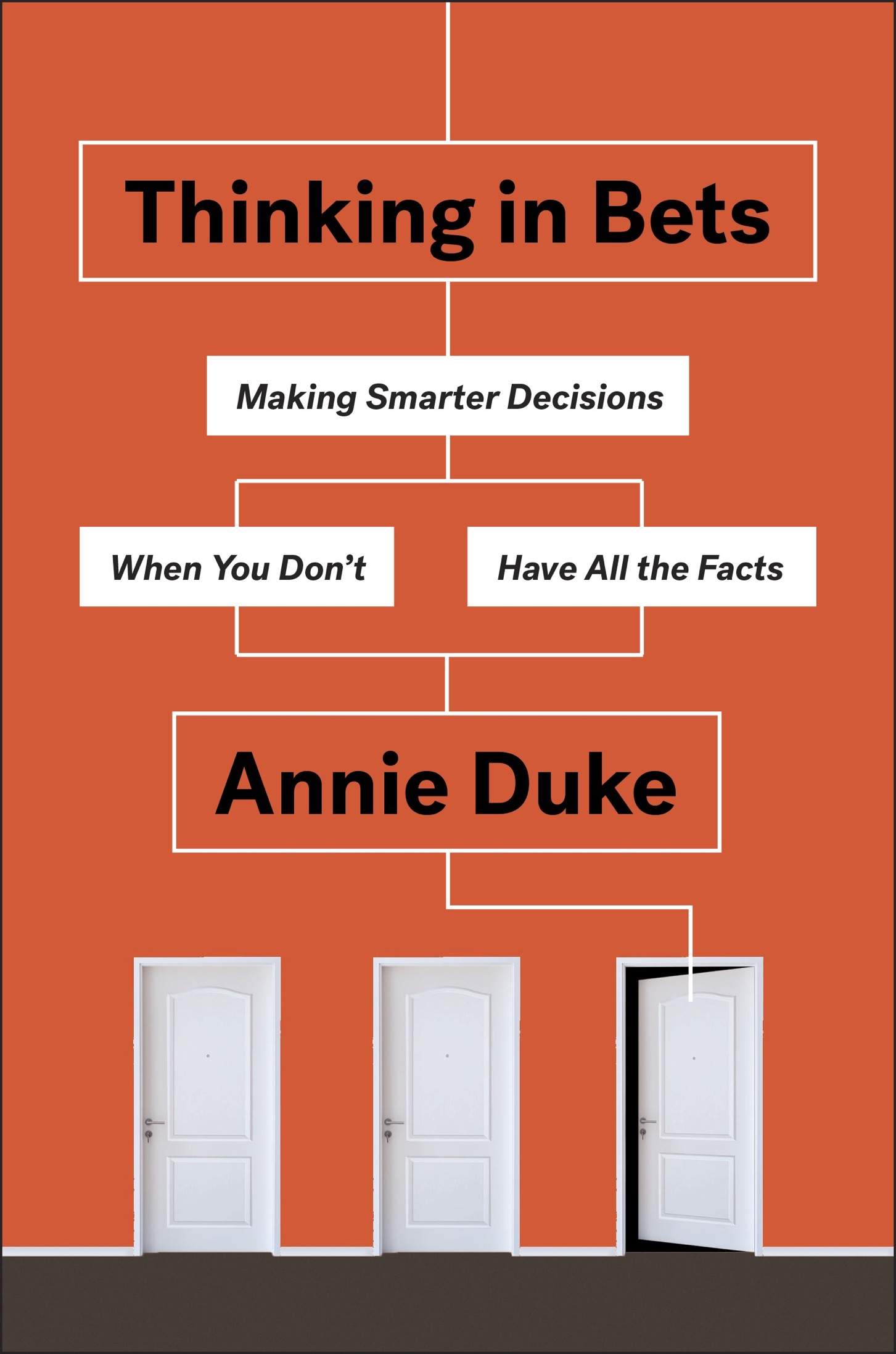
Thinking in Bets, Making Smarter Decisions When You Don't Have All the Facts
Annie Duke's Thinking in Bets leverages poker—not as a gambling manual but as a framework for navigating uncertainty (see Antifragil on thriving under uncertainty)—to teach how to separate decision quality from outcomes. Unlike chess, which operates with complete information and deterministic results, poker mirrors real life through hidden information, chance, and incomplete data. The central insight is that decisions are bets on uncertain futures, where outcomes reflect both choice quality and luck, making outcome-based evaluation dangerously misleading. This process-over-outcome framing echoes Habit Systems (systems vs goals) and Seth Godin's emphasis on distinguishing decision quality from outcomes.
Our brains complicate this reality. Evolved to seek certainty through fast, reflexive processing (System 1) rather than deliberate probabilistic analysis (System 2)—the dual-process model explored extensively in Thinking, Fast and Slow—we routinely commit "resulting"—the cognitive error of judging decision quality solely by whether outcomes were good or bad. This bias compounds with hindsight bias (viewing past events as inevitable) and self-serving bias (crediting wins to skill while blaming losses on luck), preventing accurate learning. Duke identifies motivated reasoning as a deeper obstacle: we default to accepting information as true and interpret new evidence to confirm existing beliefs rather than update them (see Cognitive Ease on how ease signals bias judgment, and What You See is All There is (WYSIATI) on jumping to conclusions from limited evidence). Intelligence often worsens this problem by enabling sophisticated rationalization of biased positions.
The antidote is probabilistic thinking. Treating beliefs as bets forces us to quantify uncertainty (e.g., "70% confident"), reject false binary "right/wrong" judgments, and adopt the "Wanna bet?" mindset (see Super Thinking for a broader catalog of mental models for decision-making). This mental shift triggers vetting of evidence and reduces defensive reactions to contradictory information. Communicating uncertainty explicitly increases credibility and invites collaborative truth-seeking rather than confrontational debate.
Because individual objectivity is difficult to sustain against these cognitive currents, Duke advocates for truthseeking pods—decision groups operating under explicit charters that reward exploratory thought (accuracy-seeking) over confirmatory thought (validation-seeking). Effective groups employ diversity of viewpoints to fill individual blind spots, structured dissent mechanisms (red teams, devil's advocates), and Merton's CUDOS norms: Communism (radical data sharing), Universalism (evaluating ideas independent of source), Disinterestedness (avoiding conflicts of interest), and Organized Skepticism. Betting markets and accountability mechanisms further reduce motivated reasoning by creating consequences for biased analysis.
To execute these intentions amid emotional pressure, Duke offers mental time travel techniques to overcome present bias (see Discipline on present bias as a depletable resource). The 10-10-10 method evaluates consequences over ten minutes, months, and years; backcasting works backward from success to identify necessary steps; premortems imagine failure to identify obstacles and counter optimism bias. Ulysses contracts—precommitments that bind present action to past rational intent—create decision interrupts that prevent "tilt" (emotional unhinging) and impulsive choices (parallels Habit Stacking's principle of designing systems where your future self defaults to better choices). Writing down your options and their odds before you decide helps prevent hindsight bias — the tendency to look back and convince yourself you "knew it all along".
Ultimately, Duke argues that good decision-making requires accepting "I'm not sure" as sophistication rather than weakness. By fielding outcomes objectively—accurately attributing results to luck or skill—and focusing on process over individual results, we create compounding Feedback Loop that improve judgment over time. This shift from outcome-focused evaluation to probabilistic truth-seeking allows us to learn from experience without ego distortion, make better long-term bets, and navigate uncertainty with the clarity that poker demands and life requires. The corruption-of-the-count problem (see The Corruption of the Count's reference to Thinking in Bets) reminds us that scoring systems can divorce measurement from genuine signal—exactly the resulting trap Duke warns against.